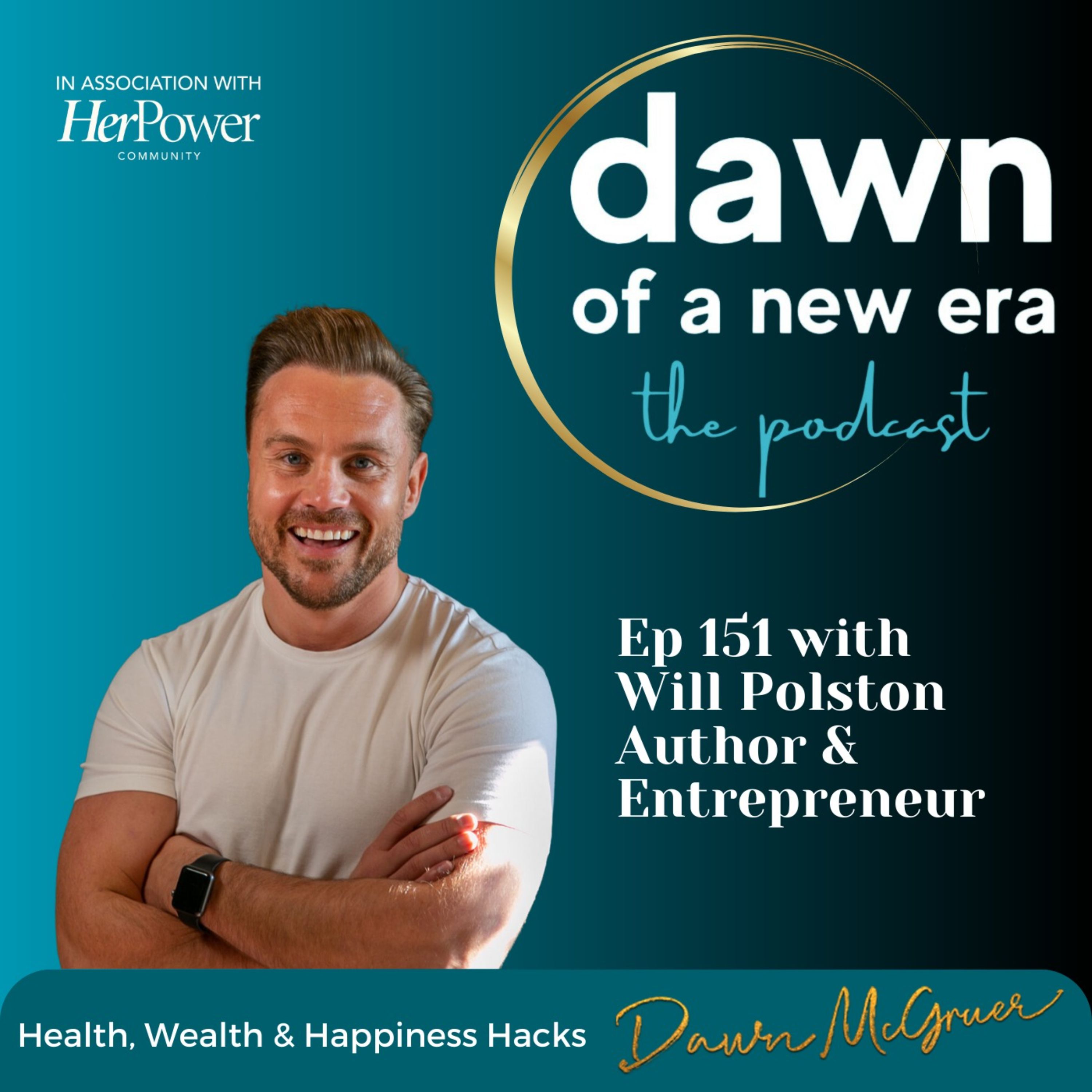
Master Your Mindset: The Key to a Life You Love with Will Polston
What if the next milestone is not the thing that will finally make you feel successful? When ambition becomes a constant pursuit of what is missing, even significant achievements can feel insufficient. This conversation examines the beliefs behind that cycle, from tying happiness to money to feeling you have not yet earned the right to enjoy what you have built.
Dawn McGruer is joined by Will Polston, a coach who helps driven entrepreneurs have more time and less stress, to explore self-worth, personal definitions of success and his concept of a ‘North Star’. They discuss the pull of ‘when-then syndrome’, the value of reviewing goals weekly and why recognising progress matters as much as deciding what comes next.
For female founders scaling towards seven figures, this episode offers space to question whether your goals reflect your values or simply another measure of achievement. Listen for a shift from endlessly chasing the gap to recognising the gains, with a clearer perspective on building a business that supports the life you actually want.
Listen to the Episode
Enjoying The Billionaire Brain®? Follow the show on Apple Podcasts so new episodes appear automatically.
Episode Highlights
Jump to a moment.
- 2:17Overcoming Limiting Beliefs
- 4:10Self-Worth and Fear of Success
- 11:04Influences and Personal Development
- 16:53Building a Support Network
- 22:21Challenges and Embarrassing Moments
- 35:57Future of Coaching and Personal Development
Full Episode Transcript
Read
This transcript was created automatically and may contain small errors.
Hey, it's Dawn McGruer, the Business Growth Coach, and welcome to Dawn of a New Era, the podcast where we talk all things health, wealth and happiness, and where founders share the good, the bad and ugly of being an entrepreneur. Welcome, Will, to Dawn of a New Era, and thank you for travelling to meet us in the studio in Manchester. So before we go any further, obviously we've met multiple times. I wasn't aware of the first meet because I was on stage.
Second time we were in a room part of a network. But share a little bit about who you are and what you do. Manageable Poston, and I help driven entrepreneurs to have more time and less stress, is the super short version. And when did you first start your business?
So my coaching business, I started nine years ago. It's kind of been a business of two halves because COVID, for a lot of people, changed a lot of stuff. It's really funny. So only Monday, I was chatting to someone.
They were talking about how can you get started with producing online videos, and I said, literally just start and get perfect later. And I actually was able to find my first ever video I did on the 31st of December 2015, and it actually made me cry. And it made me cry for two reasons. One, because it was how bad it was.
No, I'm kidding. It made me cry because the exact same message that I was talking about then is the same stuff I talk about now, nine years later. And I cannot for the life of you tell me what I said in that video. Do I remember doing the video?
Absolutely, because I recorded it about 12 times before I actually posted it. But talking about the same thing then as I do now, which is helping people to live their, what I call North Star, which is a mission in life that's the equivalent of trying to empty the sea with a spoon. So yeah, that was all the way back then, but it made me cry just because it made me realise how raw the passion was, and I had no idea how I was going to do stuff. I just knew I wanted to do it, and I just looked at that next step and that first step and went back and went, wow, I had no idea back then, but I just did it anyway.
See, I always think it's so interesting when you talk to entrepreneurs because One of the commonalities that I see a lot is the vision. So when I first started at 21, I was so passionate and I was just so eager that no challenge was a challenge. And I think it's interesting when you talk about the way that your business started, because what we have in our mind is we've taken away some of the limiting beliefs and we're kind of prepared to step past them. And I see this in a lot of entrepreneurs' journeys.
What do you think has been the biggest limiting belief that you've encountered on your journey? That I'm not deserving. Like lots of beliefs that we have, they come from our programming as children and whatnot. And I think that there was a, maybe even sort of subconscious, unconscious way that my parents brought me up, and this is not blaming them by any means.
They only wanted the best, which was you get rewards when you've done certain things. And there's a combination of wanting to do things and have a reward because you've done it, which I get. I understand the element of that. But then there's this part of me going, well, I can't do that yet because I don't deserve it, because I'm not X yet.
And I think that there's so many people that have this belief of, I don't deserve it. I'm not good enough yet. If you continue to believe that, you'll never be good enough. Every single month there is something that I will maybe not, I'll be resistant of putting out on social media or saying, because I think, oh, am I good enough to say that?
Can I even ask that question? Can I do that? Yeah, I think that's definitely one for sure. I think self-worth comes up a lot for men and women in business because a lot of us are busy building the businesses, doing things for others, that we forget about our own self-care, our own self-compassion.
And I think as business owners, it's quite tempting also to have the negative self-talk that we are very critical on what we're doing. And as we're moving forward, there's almost a kind of a belief of like, well, what happens if it all gets taken away? Have you experienced the fear through success? I see it more and more and more.
So the majority of my private clients are entrepreneurs that are turning over seven, eight, nine figures. One of my clients had a multi-nine-figure exit. And what's interesting is it's the same drive that gets them going and enables them to achieve success, quote unquote traditional success, that they then find themselves going, well, I still need to do that next thing. I'm not there yet.
I call it when-then syndrome. When I achieve this, then I'll be happy. When I get that, then I'll be content. When I get this, then I'll be at peace.
And it doesn't, they keep driving and driving and driving, like some obscene amounts of success that a lot of these people have. And you ask them, are you successful? They go, no, not yet, because I've not done this part or this part. And that's the big difference between switching to focus on the gain of what you've already achieved rather than constantly looking at the gap.
But it's the gap that drives them in the beginning for so long. I think it's also interesting that we've had conversations in the group we're part of where people have different understandings of success, which I love. And the fact that success is not, you know, a monetary step. Like, it's part of it.
You know, every business needs to be profitable and sustainable and even sellable. But sometimes I think we get caught up in the online focus of this kind of seven, eight, nine figures. One of the things that I love is that I've kind of hit a point where I feel like I'm in balance, and I don't need to go further on the financial side of things. I've got more of a focus towards enrichment and experiences rather than the monetary.
What's been your Shift in terms of, like, starting your business. How old were you when you first started? First proper business was 24. So what's been the difference in your values and your motivating factors then?
Because mine have changed a lot since 21 to 31 to 45. Yeah, well, I suppose it'd be interesting if I go back and give you a bit of the backstory. So I grew up with a belief that money equaled happiness. I've got two very wealthy uncles.
One's a billionaire, the other one's a multi-multi-millionaire. And my dad always used to say they just got lucky. That was his thing. They just got lucky.
They just got lucky. I was very fortunate growing up. I always had clothes on my back, food in the fridge. We went on holiday every year, albeit they weren't always big, crazy, lavish holidays, but I had a very fortunate upbringing.
But what I remember growing up was how much my dad hated his job. So he would get up at five o'clock in the morning, get on his bike, ride to the station, go into London, do a job he hated, come home and bring the stress and the frustration home with him. And I don't know if anyone listening to this can relate to someone in their life that when they're around that person, they can just feel the tension. It's like a force field that they can feel, and that was the case with my dad.
And then I remember, I must have been about 10 years old. And one day my dad came home from work, and I was at home from school, and he was there already. I was like, This is weird. Dad's never normally home this early.
And it's because he'd quit his job, and he'd quit his job to set up a business with one of my uncles. And at the time, I was like, Yes, this is going to be amazing. Dad's going to be just like Uncle Steve, and he's going to be happy and content, because my Uncle Steve in particular, he's this real extrovert, great character, always full of energy. He was going to set up that business.
Fast forward a few months, he'd already quit his job. I was the eldest of four. I had two brothers and sisters who were seven, they're twins, and then a baby sister who was not even one, and my mum. Then there was no job, no income, and my dad fell into what we would call a depression.
You know, curtain shut all day, didn't leave the house, very stereotypical in that respect. And I was 10 years old, and I just started to connect the dots, and it was really obvious for me. Uncle Mark, billionaire, really happy. Uncle Steve, multimillionaire, really happy.
Dad, when he worked in London, okay, he was stressed and frustrated a bit, but he was a lot happier when he was working than now. He has no money, he doesn't leave the house. So for me at 10 years old, it was obvious: money equals happiness. So I went off on that journey to make as much money as I could as early as I could.
I was the kid in school buying and selling sweets and buying stuff off. I was looking for stuff in the paper, seeing what it was priced at eBay, and if I could get it for more money on eBay, I would buy it out the paper and then put it straight on eBay and doing all this stuff. I had two or three paper rounds, I think, when I was 13 or 14. Yeah, it must have been 12 or 13, because then I started working in a bar when I was 14.
And that was my thing. Money equalled happiness, and then I started making money. I remember being 14 years old, and this is now 20 years later, being 14 years old and making £200 a week cash. The time we're recording this is, we just talked about the budget, and the budget for a certain age group is ten.
I was earning ten pounds an hour 20 years ago, so it's a lot of money. And I would just buy stuff, and that's what I would do. I would buy stuff, and I then started buying clothes, and I really liked clothes. And then fast forward a little bit, I ended up wanting to run my own clothes shop.
And the reason I wanted to run my own designer clothes shop was because the guy was a multimillionaire, and that's what I wanted to be. I wanted to be a multimillionaire and do something I loved, which was being involved with fashion. And there's a long-winded story, but I'm not going to go into it all now, but I ended up leaving that industry and then working in financial services, and I was a broker. By the time I was in my late teens, early twenties, I was making 20 grand a month, and that went on for some years.
I stumbled across personal development when I was about 18, and I loved personal development because the more personal development I did, the more money I made, and that went on for some years. And then it was 11 years ago that I went to an event with Tony Robbins, and many people listening to this would have heard of Tony Robbins, and that's when I had my lightning moment, and bam, it just hit me, and I cried my eyes out for about 15 minutes because in that moment, I realized my real driver was nothing to do with money. It had never been about money. It was to do with my dad.
Now, my dad hadn't achieved certain things.
capable of, and the impact that had on him and my mum and me and my family and a whole host of other people. And I vowed I don't want anyone else to ever have to go through the suffering that he went through and we went through. From that moment 11 years ago, it completely altered the trajectory of my life. So to your question of, have I ever had any belief values change?
That moment there was a pivotal moment, and life went in a completely different direction. Yeah, I think it's so interesting, isn't it? Because when we start a business, obviously money and cash is the king. We need to focus on getting consistent cash flow and building the business.
And again, with clients, and you'll know yourself, that it's often the biggest worry and the biggest scaling factor that they're focused on. So if you think about your values now, what is it that lights you up in business? Like, what is the true dream that is why you do what you do? So for me, still is around self-mastery.
I'm obsessed with anything to do with self-mastery, particularly mindset. I'm fascinated by it because I always come back to how can you have two different people that get the same information, but one goes and does stuff and one doesn't? You know, I find that fascinating. So that's something that lights me up.
I have a real interest in business and building businesses. So I suppose that's one of the reasons why I work with a lot of entrepreneurs and business owners, because I have the very fortunate position of being able to parachute into their businesses and understand what's going on and love that variety. So it's essentially unlocking people. It's unlocking people, whatever the barrier is to achieve their dream life faster.
You said it earlier, success is subjective, right? Success for every single person is different. So if we can get them really, really clear on, well, what does that success look like for a point in time? Not necessarily it's going to change over time, but if we can get clear on that, and then we can just break down those barriers and— Remove them or make them smaller, then they're going to get to where they want to get to faster.
So from a mindset point of view, obviously you've invested a lot in that, and a lot of people will be kind of newer on their journey. So when you see people talking about, like, top books and things online or podcasts, like, what are the things that you remember, like, really listened to or you read that changed your thought process? You can read the same book over the course of three or five years. You know, read it each year, and every time take something different from it.
There's one book that I've read. I've read it every summer holiday since I very first read it, which is a bit of a cliché personal development book. It's a book called The Secret by Rhonda Byrne. It's about the law of attraction.
And the reason why it was so profound for me was not because it introduced me to this new idea. What it did was it made me realise that I'd been doing this thing that had worked for me. I mean, when I was in my early teens, mid-teens, anything I wanted, I got. I wanted a mini motor, I'd get it.
I wanted an electric, I wanted a petrol scooter, I'd get it. These things, so I'd visualise it, I would see it, I would do the work to be able to get it, and I went, Ah, so that's what I've been doing. I think that for so many people, when you ask them what's their most profound personal development book, for the majority of people, it's almost always the first book they've read. So for some people, it's normally one of the classics, Seven Habits of Highly Effective People, Think and Grow Rich.
In my instance, The Secret, because what it does is it has the biggest knowledge jump, and then everything else is incremental gain. Others, as time goes on, if people are getting a little bit bigger, for particularly the people in their business right now that they've got lots of work, they're very busy, then a book called The E-Myth by Michael Gerber is really good. And if people are a little bit more experienced, if people are, I would say, a million quid plus, even 500K plus in running their business, a must-read book is The Road Less Stupid by Keith Cunningham. Have you seen the hype now for Greenlights?
I think everyone's reading it. I've just read it on holiday. What's your view? Read or not read?
Read. I thought it was going to be more of a personal development book for some reason. I think it's because it was promoted so much in personal development circles and whatnot. What really impressed me was, my God, that guy's lived a life.
He has absolutely lived a life. And it's very easy to look at Hollywood actors and think, well, when they've made it, they've taken off and they've really had it. But from a very, very young age, and don't get me wrong, he's had some tough times growing up, and those things have definitely been a fact. Yeah, it was an interesting read, getting a bit of an insight into his life with some lessons along the way.
And what fascinated me, I'm a big journaler on the way up here, I was journaling away, but for, I can't remember how long it had been at the time when he wrote the book, I think for 35 years he's journaled pretty much every day, and real detailed stuff, which a modern-day version of that is like going on Facebook and looking at your memories, isn't it? You go back and see 10, 15 years ago. Imagine doing 35 years of that. So yeah, incredible.
So I'm so passionate about the world of neuroscience, and one of my first books that I read and absolutely loved was Mapping the Mind by Rita Carter. It kind of really got me into understanding the psyche of people's behaviour and habits. So I wanted to understand why people did things and why we would have maybe such different belief systems or values around things. And what I talk about now really is all about sort of healthy habits, changing habits, and switching the environment rather than the habit.
What would be your biggest sort of growth habit, whether it's across health or wealth or happiness? I actually think it's the importance of, and I do this weekly, reviewing your goals. I think it really is as simple as that. So I have a process called Create a North Star, which is this mission in life, and then we reverse engineer it, which is what I call a North Star trajectory.
It's essentially a plan of goals that you're working towards. And I like to read it every week, and then I colour code the progress on the time frame that's ahead. So for example, it might be the month ahead, I'm colour coding green if it's done, amber if it's in progress, red if it's done. And it does two things.
One is that it gets me to acknowledge the progress that I'm making, because there's so much that we forget when we think of the seven areas of life, how many things that we're doing that we don't even acknowledge that we're doing. This is one of the things that I see a lot in a lot of high performers. It's always next, next, next. What's the next thing?
What's the next thing? They haven't taken stock and just gone, do you know what, actually, I'm going to bask in what I've done. So that's definitely a factor. The second one, you talk about neuroscience, there's a part of the brain called the reticular activating system, which enables you to focus.
So if you've ever had that experience where you've really wanted a particular bag because no one's got this bag, you get the bag and then you see it everywhere. Or no one's got that car in that colour, you get the car and you see it everywhere. That's the reticular activating system, which is the, like I say, the part of the brain that helps us focus. And if we can constantly stay focused on those goals, not only does it, it can help us keep disciplined, but it can also help us see opportunities and go, Oh, that'd be a great opportunity to connect up with that, and out of sight, out of mind.
So I think that can be definitely one of the most powerful for people looking to accomplish more personally, professionally, or financially. No, I love that, and I like the strategicness of it. I think one of the things that I always think about in terms of, like, growth habits, if someone said to me, What's, like, your number one do or die? It's like stepping out of our heads and getting out of the weeds.
One of the things that I think happens, and this has happened to me numerous times as an entrepreneur, is that we get so attached to the doing. You know, there could be a to-do list of, like, 5,000 things, but, like, why are we doing it? And I think the thing is, is that as I've grown older, I've got calmer and just more kind of considered, I think, in my approach to things, where you see people dashing to do things or something is not working, I have adopted a far slower approach to things because I think when you step out of the situation and you look at the bigger picture and you look at your values and your beliefs now and your motivators, it's like, why are we doing these things? What is the biggest piece of advice you could give entrepreneurs in terms of, like, just moving the hell forward?
Get around bigger thinkers. Yeah, get around bigger thinkers. So don't get me wrong, it's a blessing and a curse, like most things in life. I remember the family that's achieved extreme success, extreme success, and it's very easy to then go, Well...
Comparison, right? But what it's also done is it's given me this amazing glimpse into what's possible, because lots of people go, Well, that would be amazing, but that doesn't happen to people like me. I can't say that. I just, I don't have that ability to do that because we've seen it happen.
So I think being around big thinkers, I have had a process for, I don't know however long now, where I used to keep a list of people that influence me, I admire and trust. So people that influence me, admire and trust. And there's two types of these people. Some of these people will be people that I know.
So it might be a friend of mine. It might be somebody in the local area that I look up to. For me, it was some people that were a bit older than me that I used to play rugby with that I really respected. So they're what I call direct mentors.
And then there's indirect mentors, so people I've never met and probably will never met, but I can still connect with them because I can read their autobiographies, or I can listen to their podcasts, or I can watch them on YouTube, or I can go to their events. And getting around these people, and it's amazing that when you surround yourself with their world, even just by listening to them, it starts to give you a bit of an insight into how they think. Yeah, I think being able to think bigger is great because more often than not, many of us will realize that thinking bigger isn't about doing more; it's just about doing different. Yeah, totally.
And I always think about community and connection as my marketing plan. It's like the absolute pinnacle of everything. So I think detaching ourselves from the actual process and thinking more around the benefit. I think one of the things that, when I talk to entrepreneurs, that it fascinates me is that we forget how powerful our networks are and the people that we...
And there's always somebody who has influenced the direction or the trajectory of where we've gone in business. Who was your biggest influence in terms of, like, a big growth change in your business or, like, a complete juxtaposition of where you were going? I suppose in my life, it was Tony Robbins when I had that big event way, way back when. Some of the people that have helped me change are because I've modelled them from afar.
So they're not even people, like coaches, that I've actually paid and said, Do this, do this, do this, but they're people that I've modelled and gone, Ah, well, they do that over there. What about if we did this here in a different industry? I've said for years that champagne is a blend of different grapes, right? So if we can take those different grapes and squeeze it, we make champagne.
And so there was a guy, Mark Davis. He had a TEDx license, and people were talking about this guy, Mark, and he was really real respected. There was a big organisation that still exists, albeit in a different way, called the Yes Group, and he used to be the Yes Group London leader. They used to have like 800 people come, and I really wanted to run these events.
And I had this idea of imagine a personal development sort of big seminar, the ones you go to in London or Birmingham, big city over four days. I thought, well, what if we just had that every month and it was just two hours or three hours and we had two guest speakers at every event? And I had one major issue in that I didn't know any speakers. So I thought, well, Mark owns a TEDx license, and he used to be part of this thing called the Yes Group.
Maybe he knows some speakers. And I reached out to him, and we sat down and we went through it, and he said, Yeah, this would be great. And then he said, Ah, and I know what you could do. You could look at adding another layer in, which would be a mastermind group.
And at the time, he likened it to an organization called Vistage, which are sort of peer-to-peer sort of board peer groups. And I was like, Yeah, I can see why that would work, and that was what started my first ever mastermind. So that's an example of having some influence from somebody I had no idea, but he said, Well, what about? And I think those what about this or what about that?
Sometimes you can just bat the ideas away, and sometimes they could be great runners, because we've now got a number of different mastermind groups that have been going for eight-plus years. I think sometimes it's not always like the most influential people. It can just be a circumstance, or even just one person saying something at the right time that can change your whole way of thinking. Now, we always talk about the good, the bad, and the ugly of entrepreneurship, and you know what's coming.
I always like to ask for the most embarrassing story, because I think the thing is, I always share my stories, and anyone on my mastermind or retreats knows a lot of embarrassing stories. But what was the most embarrassing story in your business life? One that stands out, and it's not even that bad, really, but at the time it really haunted me, was I talk fast, I type fast, I do certain things at speed a lot of the time, and I sent out this email about setting out your stall, and the subject line was, Setting out your stall, only to then send it out to however many thousand people on the email list and get, I couldn't tell you how many dozen replies saying, I think you meant stall, as in S-T-A-L-L, and I'd put, Setting out your stool, S-T-O-O-L, as in poo. So that was one of those moments where you sort of...
Heart sinks and you go, Oh, why didn't I just double-check that email that I sent out? So that's one example that comes to mind. It is one of those things because I really did go, Oh my God, I can't believe I've done that, and just felt so ashamed for a few hours. It's funny though, isn't it?
We put such, like, pressure on ourselves, and we've all done it. Like, you know, even today we'll have, you know, in probably the past week or month, done something or, you know, said something that wasn't right. And when you said that, it just reminded me of when we were doing captions on a video, and when I say the word popular, for some reason it recognizes it as cop killer. Thankfully, just before it uploaded to YouTube, we noticed it.
But, you know, we've all sent these things out, but we beat ourselves up, don't we, that an email wasn't right. And I think I used to hold on to that a lot more when I was younger. Now, not so much. I think, you know, we all make errors.
What's your view on, obviously, people who are very controversial online? Because we see a lot of this, and a lot of people are trying to carve out a brand around being super controversial, or we see a lot of people jumping in on comments. And, you know, I see it online. I have to kind of distance myself because I find it quite harsh, some of the times that people are naming, shaming, condemning.
There's a lot of opinion, but what is overstepping the mark these days? It's the rants. The irony of what we're about, what I'm about to say is one of the things that I can't stand is people that just rant, but rant for the sake of ranting because they know it's whipping up a storm. And there's a particular guy that I'm doing some work with at the moment, and part of the content plan, it's da-da-da-da, and on this day you do a rant.
And I'm just not doing it. And I appreciate the irony in what I'm saying because the thing I'm ranting about is ranting, right? So, but yeah, it's people that whipping people up for a frenzy. A perfect example of this is the political situation without going into politics in the UK and definitely over in the US at the moment.
It has gone— So far that there is just no rules anymore for these. There is no moral line that people can cross to be bad. And I think that's a dangerous position when you've got the major political parties of major economies that are operating that way. And yeah, people do it for the likes, they do it for the engagement, and they do what they do.
But I know that I generally take a bit of a vanilla stance, not because I am afraid of being shot down or anything like that. It's not a fear—well, at least I don't think it's a fear of tall poppy syndrome. It's more just, I just can't be bothered with it. I just can't be bothered with it, and I really attempt to have a balanced view on things.
And by having that balanced perspective, it means that I don't have judgments one way or another, because ultimately there's 4,828, I think, human traits, and every one of us have them. So if people are saying, I can't believe that person is making fun of other people, well, there'll be a time when you've made fun of other people, so you end up just becoming a hypocrite. I read something the other day that has stuck with me, the fact that we have about 4,000 weeks in our life. Like, that is quite scary.
And when you start to quantify it with a number, you start to think like, you know, well, next week that will be like 3,000 whatever. What is your biggest mission in terms of, like, leading a life that has impact, but not just for other people, but for you? Like, what is the legacy you want to do for Will? Well, and this is a good one to talk about, because people talk about that 4,000 weeks, and beliefs are powerful.
You know this, Dawn, they're so powerful. And if people are told something enough, whether it's true or not, they'll believe it. And I think the fact that 4,000 weeks may be of what people have lived to until now. But that definitely isn't going to be the case moving forward.
There's going to be people in our lifetime, our generation, that are living to 120, and not just living to 120 as spending 40 years as a decrepit old person with a walking stick or being pushed around a wheelchair, but as active as we are today. Like, that is happening. And I've got a real interest in life longevity, and one of my things is I want to live to 150 years old. And there'll be people that listen to this now going, Who is this delusional guy she's got on the podcast?
But actually, if you start looking into the sciences and you look into epigenetics and you look into the developments in the human genome, and there's an amazing book called Lifespan by Dr. David Sinclair, and there's a whole bunch of people, Mark Hyman and a whole bunch of others that are doing really great work on this that are making us Become aware that this is going to be more than possible within our lifetime. So that's one of the first things. But for me, it's about empowering people to live a life that they love and giving them the tools to be able to do that.
Because I think that so many people, we all get schooled, but we don't all get an education, right? So if we can get this knowledge and the stuff that you've learned over the years of being an entrepreneur, that just imagine if you'd have been taught that from five years old, like you are maths and English and some of these other topics, and mindfulness and the power of mind, the book that you mentioned. You know, if you'd been given that when you were 11, I know you started super early and super successful really early on, and I know you built networks and used to run your events at Aston Martin garages, and you were doing those things and they were so powerful. But imagine knowing that stuff at 11.
Oh, it's crazy, honestly. I feel that I've been always passionate about bridging the digital skills gap, talking about, you know, women in tech and gender pay gap and things like that. But I think what is changing, and we're seeing a shift, is the amount of women who are speaking on stages, starting podcasts, and actually scaling businesses. Because I honestly feel that from the age of 20 to like 35, it was a very solo journey in a male-dominated world.
Every time I showed up on stage, it was men. Every time I was going on podcasts, it was men. And even now, there are very few female speakers in comparison to men. And also, even if you look at the charts, the amount of podcasts that are in the top 50.
So it's a real passion for me to see women move forward. How have you seen women in business change since you've been in business? I run a group of entrepreneurs, and one of the three rules that we have is that they have to turn over a million pound plus. And there is probably only, it bounces between 15 and 20 percent of people in that group that are women.
And that's not because— We don't, we're trying to keep women out.
There are just not that many of them that are turning over a million quid plus. Now, the irony is, out of the 140-odd people in the group, the person in the group that does 200 million is a woman, right? So you go from one extreme to another. What I've seen is that there's a lot that's changed in years gone by with technology.
So technology enables us to be able to do more faster. COVID made working from home acceptable for a lot of people, so they've been able to do certain things that they've wanted to do. And I think for a lot of women, and I'm really interested in your opinion on this, is that a lot of them get caught in this dilemma between, well, I would really love to do this, but also I do really want to be able to be there for the kids and do this and do that. And in years gone by, they've had to make—not had to, but there's been a choice that's been made.
And technology has enabled working from home and doing these things has enabled that, I believe, to become easier. I think there's probably a lot of, like, stigmas and societal norms that women have felt maybe compelled to adhere to because there is that kind of guilt that if they do have a family, that should they be working and going out and about? And last week I heard a story of a lady who had a baby who is in my network. She hasn't even announced it on social media because she's working in tech, and she lost one of her investors because she was pregnant.
And I think this is really quite scary that we're seeing this now. It's like, what can we do to shift these mindsets and challenge these norms? And I think this is an interesting conversation because obviously I talk to men and women about it. Where do you see the change coming to get more women to scale to a million?
I think it comes back to— What do they want? You know, if they want to do it, great. Well then, in the same way that you equipped people to be able to move into the digital environment, you were one of the really early adopters. You created your training schools and your curriculums that enabled people to go, I want to do this.
And what you're able to do is you're able to bridge that gap. And I think the more people go, Well, I would love to do this. I just don't know the how. For the majority of people, it's not that they don't know what they want to do.
It's just they don't know the how. And the more those bridges can be gapped and go, Well, this can be done, and here's an example of somebody that's done it, and here's an example of somebody that's done it. And it's the same for guys as well. You know, I've got so many—I'm at an age where a lot of my friends are having kids, and they're the same.
They want to be able to do the school run. They want to be able to be there for after-school clubs and to be able to watch whatever. They want to be able to do these things, and it's a case of just knowing, well, how and who's done it, in a way where they've been able to do both. And I think that's the difference.
Yeah, finding the flexibility so that it works. And I think it is, it's like balance. I mean, there is no true work-life balance. I think, like, sometimes work wins, sometimes home wins, sometimes there's a blend.
But I think now with technology, there is more opportunity. And I guess it comes down to understanding or having the belief that, like, infinite success is possible for all of us. It's just a choice. And I think maybe perception is now that, you know, there are more people doing it and there are more people kind of bridging that gap.
I'm not saying that a million has to be the milestone. I mean, it could be that someone has a business that's a hundred thousand, and that's their absolute dream. Where is your dream, like your vision for Will in the next five, ten years? Like, where do you want to take your business?
Attempting to do is create the go-to platform for personal development for entrepreneurs in the UK. So, in terms of online resources, having everything where people can come together, the community element is a huge component. Content is a huge element. I'm a massive believer in collaboration and having great people, great minds with great knowledge that can come onto the platform, share via the platform, have the community element that connects people, have the coaching for people that want to maybe accelerate that and bridge those—or not bridge, but have those three elements to help people bridge that transition.
So if they don't know what they want, we can help them get clear on what they want to do. If they know what they want to do but they don't know how to do it, we can help them do it. And that's really something that I do feel passionate about. You mentioned it early on, you know, vision is what is that vision?
What does it look like? Like, practically, if you were to close your eyes and imagine waking up on your ideal day, where are you waking up? Who are you waking up with? What's the next thing you're going to go and do?
I know you love your— is it Wellness Wednesdays? Yeah, Wellness Wednesdays and Free Time Fridays. Yeah, Wellness Wednesdays and Free Time Fridays, and being able to have these things, okay, well, that's what I want to be able to do, and then I want to go and do a bit of this, and then I want to go and do a bit of this. And it comes down to choice, and I think that's why so many people go into business.
The majority of, even though they might say they're going into business for money, they're not going into business for money. They're going into business for freedom, and the money they perceive gives them the freedom in the majority of cases. So how do you create that life that gives you the freedom, whether it's the holidays, whether it's this, whether it's that, whatever it might be that enables you to do things, or other people's freedom. So for a lot of people, it's they want to be able to earn a certain amount of money to be able to give their children or their grandchildren or their grandchildren's children the freedom to be able to do what they would really love to do.
And that's where I think that we will see more and more people, when they've got those role models of being able to say, Hey, look, I was able to do really well in business, but I didn't sacrifice my family for 20 years. And that's the difference that I think online, we're only really starting to see, although we've been online since whatever it is, 1990, whatever year, but now I think it's easier than ever to be able to create an online business that can help others. Yeah, definitely. Like COVID was the catalyst there, but I would say that we've seen a huge shift in the online space and the coaching industry since then, and maybe not all positively.
There is a lot of talk about entrepreneurs being burned, having awful scenarios where they've been put off actually, you know, being in business. What's your view of the online and particularly the coaching space right now? Yeah, it is a big topic, and I'm going to link it back to you and what you did very early on. So with your academy, I know you jumped through loads of hoops that were really difficult and challenging, but it meant that you had to tick a lot of boxes and do a lot of things the quote-unquote right way, and that meant that you had to adhere to a certain protocol and code of conduct to make sure that certain things were delivered on.
And then also you had lots of these pop-up people teaching digital marketing online that have maybe got a tiny little bit of experience and all of a sudden are delivering on that. So the difference being is that you've gone and done the proper qualifications, let's call it, and got the appropriate accreditations to be able to deliver it. But because it's not something that's regulated, other people could do it. The same thing's happened with coaching.
One of the things that I did really early on when I first decided that I wanted to become a coach, I spoke to a bunch of different coaches and asked, How did you do it? What did you do? Again, modelling other people. And one of the coaches said to me, Well, one of the things I highly recommend you go and do is go and do a training course, but make sure you go and do it with one of the companies that is ICF accredited.
So the ICF is not the notorious West Ham Inter City firm, the football hooligans, but it's the International Coaching Federation. And at the time, they were regarded, and arguably still are, the gold standard of coaching accrediting body around the world. And nowadays, if people are coaches and they a lot of the time want to go into corporate, they will request for an ICF accredited coach, or if it's UK, I think it's called the AC, Association of Coaching, off the top of my head, sort of the two organisations. And what that did was it took a lot longer, but I went through a certain process.
Whereas now, people hear the word coach, and you could have someone that has learnt to lay flooring, and all of a sudden they're a flooring coach, and we just use this term, and it's not a protected term. Interestingly, accountant isn't a protected term. Anyone can call themselves an accountant, but not anyone can call themselves a chartered accountant. And there's lots of examples of charterships.
So what do I think is going to happen? I think that at some stage there will be some form of chartership that will hopefully come in because it will separate people. We will see. There are some great organisations.
So there's an organisation called CPD Standards. They created a body to essentially, I suppose you could call it, regulate coaches, because the ICF deals with creating accreditation on what you've Trained in, whereas what this particular organization were doing under the CPD standards, which is called Coach of Excellence, they're not helping you get qualified. But once you're qualified, they have this really, really strict process, and I've never seen anything like it in terms of the stuff that they wanted to get from me to prove that I've done a certain level to be able to get accredited in Coach of Excellence. So they're doing a great job, but they're still a private organization that are trying to, I suppose, quote unquote, clean up the industry.
But until you see something across the board, that's where people go, I want a coach, but I'll go with this person because they're cheaper. I need to then get burnt. And it's the same, I say, accountants as an example. People have had a really bad accountant because they didn't want to pay the money for the chartered accountant.
But the reason you pay the money for the chartered accountant is because if it goes wrong, you can claim on their professional...
Liability insurance and all that stuff, professional indemnity insurance. I mean, I don't even think a lot of coaches even know what professional indemnity is. And I guess it comes down to the fact that, I suppose, in the space we see people be successful in their business or the service they provide and then obviously think, well, I can teach that. For me, I see that more as mentoring.
And, you know, I think there's a real tricky area that when you maybe haven't gone with, and there's multiple accreditations out there. We've got our own accredited, you know, growth coaching certification. If you haven't got the tools maybe to manage some of the things that come from coaching, which is often mindset-led, this is where I think there can be some tricky territory, because I've had a lot of people come to me who have gone to somebody who is maybe a traditional mentor, and the biggest success barrier they've got is their own mindset. So regardless how much they learn, they're never going to move past it.
Or they've gone to retreats and things like that, opened themselves up. That person maybe has unlocked something, and there's been no one to manage that process through. And I've had to step in myself and do these things at events and retreats that aren't even mine. So I'm hoping, or hopeful, that we do see more of regulation around it because, you know, obviously people doing a digital marketing degree, that's one thing, but doing a coaching qualification, you know, I think there has to be a line maybe carved out of how people present themselves.
So if you think about where you'd like coaching to go, what would be your hope or vision? That it becomes a recognised professional service. So solicitors is a form of professional service, accountants is a form of professional service, just to name a couple of examples, and for it to be recognised in that way. And there is an organisation, isn't there, the Chartered Institute of Personal Development from memory, but it's being able to have it as that recognised skill.
You or I couldn't do the electrics for this building that we're in and sign them off. Because you have to be qualified in a certain way. And I think that if it gets to that level where people have to have a certain level of training, in the same way that an electrician would or a plumber would or anything else to be able to do the work with somebody, every industry is going to have guys that aren't as good as others. And you're going to have the rogues and whatever else.
But in the same way they got, or they've attempted to get rid of a lot of the rogue builders and the rogue tradespeople and all the rest of it, we're just going to follow suit, and hopefully sooner rather than later, because it will just mean that there'll be less people that are affected as a result. Yeah, and it is. It's about the person who's impacted because it can be quite catastrophic. I've always had to do CPD from a digital side of things and also for coaching, and I do around about 120 hours a year.
So I think in any practice, you would want or hope that the person was still learning themselves. What's the biggest thing in terms of your own personal development around coaching that you feel is important? Continuous learning. You know, Kaizen, continual, never-ending improvement, that constant process of growing.
There's stuff that I have learned now that I didn't know five or six years ago. And mastery for me is not a destination. Yes, you can do, if you think in traditional terms, you do your GCSEs or whatever they call them these days, then your A-levels, then you go to university and you do a degree, then you do a master's, then you do a PhD. People are just getting more and more knowledge in a specific area, and generally speaking, you niche down, don't you?
You do a PhD in a specific, really micro-niche area, and that is what I love to do. There's a few key areas that I just love to go really, really deep on and— Learn more and more and more because it becomes the nuances. That's the bit that I love, is the nuances. And I think it was Albert Einstein that said, The more I learn, the more I realize the less I know, or something to that effect.
It may not have been Einstein, and I've certainly found that to be the case. The more I'm learning, the more I'm going, Wow, I didn't realize that, and it unlocks this little bit more information, unlocks a whole another area of areas, because now I can start connecting everything up together and create these little nuances that are tiny, but actually can make a huge difference for people. So, yeah, I agree. I mean, I've been doing a lot of holistic modalities, NLP, really kind of getting into delving deeper and deeper into neuroscience and really looking at not just the process of it, but things like the habits of highly successful people and linking that back to what we can do day to day.
So, on a final note then, if you think about one parting statement or piece of advice you could give our audience, who are a mix of obviously business owners, male and female, what would that piece of advice be? To create a life or have a mission in life that you never achieve. And the reason for that is so many people, they put all of this time and this energy and this effort into a particular point in the future, which is going to be their pinnacle moment, their moment where they go, Ah, I've made it. I can kick my feet up now.
I can sit back. I can relax. There are so many people that we've worked with that have achieved, by pretty much everybody's standards, incredible success. And they get to that moment and go, Is this it?
Is this it? Is this what it's really about? Whereas if you have that mission that's the equivalent of trying to empty the sea with a teaspoon, I call it the North Star. Like, what's the North Star?
Because once upon a time, there's a famous story involving a baby that was born in December in a stable, and there was three men that found this baby and they followed the North Star, but they never went to the North Star. They just used it as their guiding light. So if you can forever use this guiding light that you accept you're never going to achieve, yes, you can create milestones that you want to achieve along the way, but you're constantly moving forward and feeling fulfilled as you're moving forward. And there will be challenges, but optimal growth comes at the border of support and challenge.
So you're growing when you're being challenged, and you're not growing, and in fact, you're potentially not growing when it's too comfortable as well. So it comes if you're not growing, you're dying, that type of view. So having that thing and working towards it, and it will ebb and it will flow and it will change, and you're not going to stay perfectly on track. But I think that that's one of the most important things that people do to have a fulfilled life, because when it comes to the end, whenever that is, whether it's in 4,000 weeks or whether it's at 150 years old—I'm living to 150—I think we all want to look back and go, Do you know what?
I gave it my all. Yeah, sure, there were times when I was a little bit scared, and sure, there were times when I thought that I wasn't going to get through it, but you can go, I gave it my all. I absolutely went for it, and I had great fulfillment along the way. And as cliche as the saying is, enjoy the journey, because that's what you can do when you've got that thing that every single day you're working towards, and no matter how small that tiny action is, it's getting you closer and closer to fulfilling that mission.
I think of it like, you know, once upon a time when we used to use computers and they used to have the loading bars. You know, a lot of them don't have them now because they're so quick, everything just loads so quickly. But it used to be loading, loading, loading, and it gets to 100% and then it was done. Whereas I think of it as a never-ending loading bar, and you constantly can look at it and go, Wow, look how much...
Blue there is, for example, if it's the blue part that's showing the progress, look how much there is, and we see it that way. I love it because it's kind of like an ever-evolving purpose, something that we are like, it's our mission, our vision, our passion. It's like we're constantly striving for something that we love and enjoy and really want to do. So if someone wants to get your book or connect with you, where is the best place to find Will?
Best place to find Will is willpolston.com. If you want to sort of head to the website, you can get to all of the social channels from there. I'm Will Polston on everything.
I'm pretty much on all the social channels. The book, Norse Thinking: Master Your Mindset and Live the Life You Love, easiest place for most people is Amazon. Amazing. Thank you so much for joining us.
Thank you for having me. Thanks for listening to Dawn of a New Era, the podcast brought to you in association with the Her Power Community. This initiative was founded by myself, and it's all about empowering female founders to recognize their limitless potential and pursue their ambitions with confidence. Now, there is less than 1.
8% that goes into investing in female-founded businesses, and we are here to make positive change. So come and support us on Instagram at Her Power Community and find out more about what we're doing to support female founders to scale and grow their businesses.
About The Billionaire Brain® Podcast
The Billionaire Brain® Podcast with Dawn McGruer, formerly Dawn of a New Era, explores the psychology, neuroscience and behaviours behind extraordinary success in business, wealth and life.
Through solo insights and conversations with founders, investors, millionaires, billionaires, authors and experts, Dawn explores how identity, thinking and behaviour shape what we create. New episodes are released regularly on Apple Podcasts, Spotify and YouTube.
- Episode · 151
- Published · 6 February 2025
- Run time · 48:45
- Host · Dawn McGruer
About Your Host
Dawn McGruer is an entrepreneur, 5× founder, award-winning keynote speaker and Forbes Books author of The Billionaire Brain®.
With more than 25 years in entrepreneurship, Dawn's work explores the intersection of founder psychology, neuroscience, wealth, identity and business growth.
Keep Listening