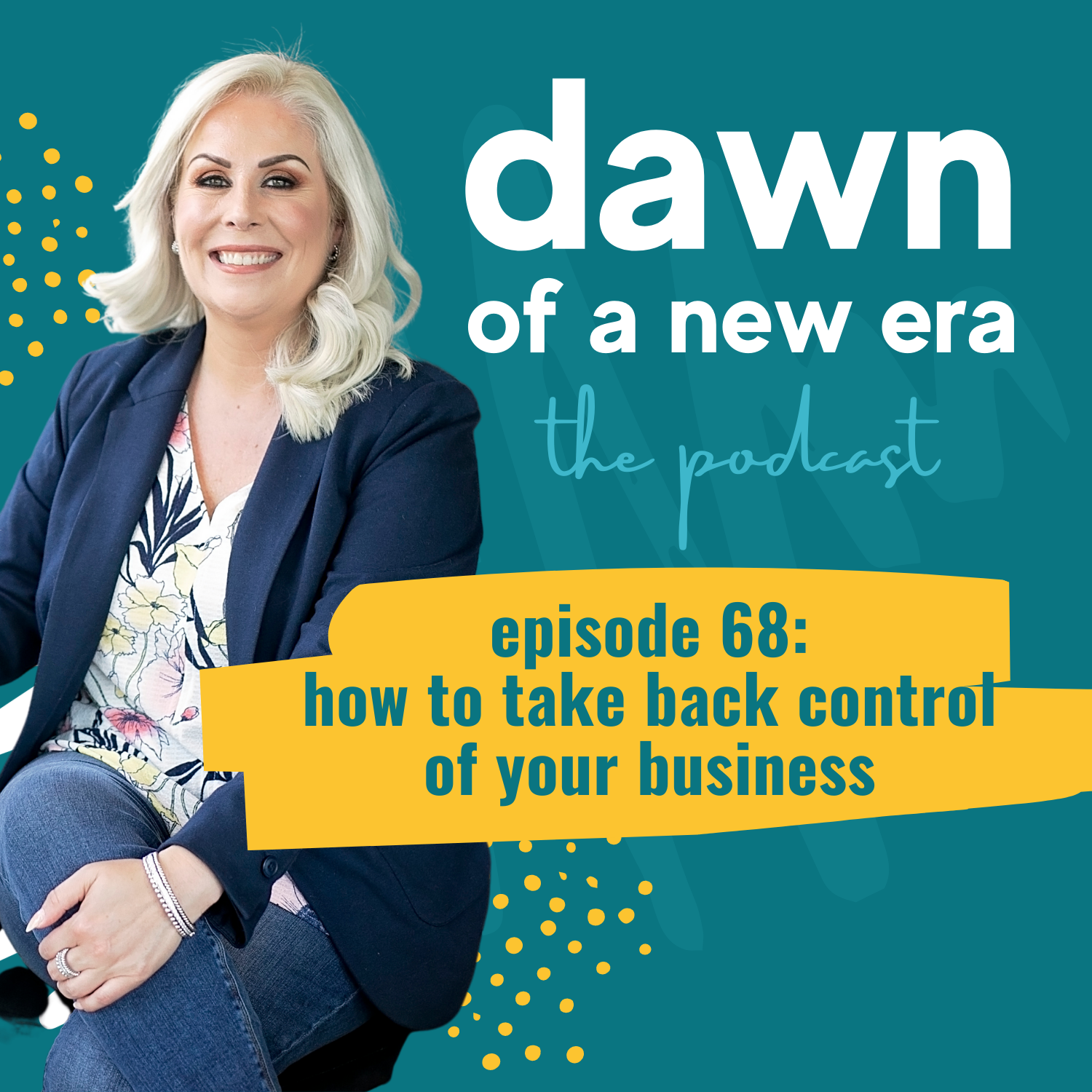
How to Take Back Control of Your Business
Are you leading your business, or letting other people’s priorities dictate its direction? When team opinions, supplier deadlines and competing projects fill every available space, taking back control starts with knowing what you want, what matters now and what can wait. An opportunity can be right for your business without being right for this quarter.
In this solo episode, Dawn McGruer explores how a one-page plan can anchor your mission, vision and goals, giving you clearer parameters for decisions. Drawing on her own experience of pressure and overcommitment, she discusses honest conversations with suppliers, the confidence to say no and the importance of allowing projects time to settle before starting something new.
For female founders managing growing teams and crowded diaries, this is a practical invitation to separate useful input from external pressure. You’ll gain a clearer approach to protecting your capacity, creating space to think and making decisions on your own terms, with self-care treated as part of running the business rather than something squeezed in afterwards.
Listen to the Episode
Enjoying The Billionaire Brain®? Follow the show on Apple Podcasts so new episodes appear automatically.
Episode Highlights
Jump to a moment.
- 03:00Create a one-page plan
- 08:16Be clear on your mission and your vision and stay strong
- 11:14Be objective to other people's thoughts and opinions
- 13:38I always build in what I call my ‘pan-out time’
- 15:08Take time out for self-care
Full Episode Transcript
Read
This transcript was created automatically and may contain small errors.
Welcome to Dawn of a New Era, a business and marketing podcast with a difference, ranking in the top 5% globally for people who want to start, scale, and grow their own business. Dawn McGruer shares tips to improve marketing, motivation, and mindset, as well as her own real-life challenges and experiences as an entrepreneur. Guests include some of the world's most inspiring leaders too. So if you are an aspiring, established, or serial entrepreneur, this is your go-to podcast to fast-track results and rise to meet today's challenges, and master the art of online influence and business success, and avoid common pitfalls along the way.
Never miss an episode and subscribe and listen at dawnmcgruer.com. Welcome to Dawn of a New Era, the podcast with a difference, talking all things marketing, motivation and mindset. And in this episode, we're going to look at how to take back control of your business.
And it sounds weird because you might think, well, I am in control of my business. If you are a business owner, you might feel like you're the driving force, that you've got everything in place. But something I've been struggling with quite lately, and to be honest, probably since I started my first business at the age of 21, is the pressure of others. And this is not just to do with looking online, seeing people, believing that they're doing bigger and better things than you.
It's not FOMO. It's actually the pressure of others and their opinions. Because in my business, there are, oh, 17 of us who are working constantly on projects, and probably another 10 who are working with us sporadically on other agency clients and other projects that we're working on. Now, that is a lot of people for me, and I know some of you will have far bigger businesses.
But even managing 30 people and taking on board everyone's views, what everyone's opinion is about what we should do, why we should do it, how we should do it, and so on, becomes a bit of a minefield. And you will find that also when people are trying to promote their products and services to you from a supplier point of view, that there can be quite a lot of pressure there too. Now, I see this with my clients, and for me, I love people's opinions, but you have to be able to cancel out the white noise. And to be able to get control in your business, you really need to understand what you want and what your ultimate goals are.
It's a bit like having the clarity around your mission and vision. So what I've started doing. And this might be a useful activity for you to try, is I have what's called a one-page plan. Now, I urge any client or anyone who's listening to this podcast to do is just take control and really understand what it is that you want to achieve, by when, and what sort of goals that you're expecting, okay?
Now, what this does from also a team point of view, but a supplier point of view, it helps put in place parameters. And this helps you take control because it shows somebody who might be putting pressure on you from a supplier point of view that they believe that, you know, if you don't take action now, you know, you're going to lose out on X, Y, and Z. You know, they're really kind of pushing you to kind of, you know, sign that contract or jump on that course or that mastermind or take them on board to get your strategic plan for your social or whatever it is in place, that the timing might not be right for you. And everything has to center around you as the hub, what is right for you and your business.
Now, this can happen in a role as well. You might be working in a role in any industry, any niche, anywhere in the world, but what you find is that you have a list of commitments and people keep putting pressure on to do other things. Now, where the one-page plan comes into play, you can use it as a role or you can use it as your business plan, but you need to take control of, you know, what are the three things you're working on right now. So try and plan out what your mission is.
So this can be from a personal point of view, or it can be from a business point of view, and it can be from a career point of view. And then start planning out what the mission is. Now, this can be an overall mission, you know, for like the next 12 months, where you want to be, and then you can have your vision of what, you know, you want to see happen. And then you can have your goals of what, you know, you want to have achieved in that period of time.
Now, what I start to do then is I start to then build in how we're going to get to those points, and I start looking at it from kind of... of our project-based activity. So if, for instance, like, you know, our goals at the moment, if I give you an indication, we are really, really looking to ramp up our exposure. Now, one of the missions that we have is to become the number one, the absolute global provider of the CIM Diploma in Professional Digital Marketing.
Now, as a CIM accredited study centre, we're definitely up there, and in the UK, it'd be very difficult not to have heard the name of the academy. Now, the areas that we work in are Australia, we work in New Zealand, we work in the US, and, you know, there's huge, huge potential that we could have. Now, it's very easy for someone to kind of get involved in that and start telling, you know, us and advising what we should be doing. But you have to take this back and think, what feels right for me?
So whatever your global mission is, right, I have three. I like to then start jotting down what we're going to do to get to that point, okay? So, for instance, one of our other missions is to really make education accessible, to, you know, to make it accessible to all walks of life, to people in all industries, all areas, all countries, and really kind of bridge this digital skills gap, okay? But how are we going to do it?
It's a big mission, right? But we've started to kind of think about, well, what would empower people? What are the problems around it? And we start formulating campaigns and projects.
Now, we do this with each aspect, okay? So the next one we have is to be the ultimate digital influencer in our space through practicing what we teach. Now, I truly believe that we're up there, but we can always improve, and we can always dominate in sectors that we've never even, you know, worked in. So there'll be people out there, unfortunately, who don't know about our brand.
Our brand, yeah. And the exciting thing is, is that when we start to think about how we can use storytelling in case studies, it becomes quite manageable. But where I feel that we need to take control back is that there is always a temptation with team members or whether you're outsourcing, is that you share your mission and your vision, and then lots of people have an opinion on what you should be doing and why. But what you have to do is think about taking on board everybody's opinion and thinking about the impact of it.
So, you know, do you agree with it? Do you feel it would move the needle in your business? Is the timing right? Now, it could be that you really love an idea of a potential partner or supplier, or it could be someone in your team, but it just feels just not quite right, or the budget isn't right right now.
And we see this so many times. I had a client who came to me last week who, they had team members who just weren't kind of bought into a supplier project, and the timing wouldn't have been right, so they took a step back. But the supplier kept, you know, moving forward and saying, you know, if you really want to make this happen, if you really want to change things, you know, and there was a lot of pressure put on. But you have to think about the motivations of others, and this is where we truly get to the point.
If you're clear on your mission and your vision, and you've got lots of ideas, stay strong, okay? Stay strong, because often your gut feeling is right. So if something feels that it's going to push the limits of resources, push the limits of budgets, don't do it, and don't be afraid to say no. So what I do is if I have pressure from a supplier, you know, perhaps, you know, we've come up with an idea and we've explored it with two or three people.
Instead of ghosting these suppliers, which you must never do, these people have put time and effort into, you know, preparing proposals or quotes, go back to them and tell them exactly where you're up to. There's nothing better than being honest. Now, you can do this with team members. Sitting down and just being kind of clear about where you're at and what order of things are going to happen in what time scale, and then when you want to maybe revisit talks or discussions or ideas.
So when you look at taking control back in your business, it's about taking some of the external pressures out. Because as you grow, as your business grows, as you accelerate your career, one thing that will always happen is that other people around you will want to join that conversation. Now, we don't want to discourage that. We think that that's a positive thing.
But you'll always come up against barriers. And my advice to you is that last week I felt really under pressure. I felt like we had so much going on with so many projects. And the thing is, is that, you know, what people forget on the outside is they never know what's going on inside of your own business or indeed your own personal life.
So for me, it was like, oh my goodness, I am traveling to LA. I can't wait, obviously. But, you know, as much as that's a business trip,
Just to mind, you know, I have to do a lot of prep for it. I'm going away for like, you know, 10 days, and then I'm running a retreat in March in Marrakesh, and again, I have to arrive and prep, etc. And people were just like, you know, when can I put this in your diary? You know, can we get this started?
And I felt pressurised, but I had to take a step back and say, look, the timing is not right. We have LA, then we have half term, then we have fast track in London for three days, fast track in Manchester for three days, then we've got a retreat in Marrakesh. Quite honestly, you know, this quarter I do not have the capacity. And just by explaining that to someone, saying that I didn't have the capacity to take on anything else in terms of, obviously, time and resource, and it wouldn't have been right.
I wouldn't have been able to put my mind and focus into it. It just gives you that clear space, that clarity to kind of take the step back and confidence in what you're doing, because by shifting something back, as much as that person wants to make it happen now, they will indeed, as I say, have their own motivations. Those motivations could be that they want to make a sale. The motivations could be that someone in your team wants to do something because, you know, they want a pay rise or a promotion, or it just could be down to their own sort of personal opinion.
But you always have to be quite objective to other people's thoughts and opinions, because at the end of the day, this is your life, this is your career and your business. This is, you know, your own job role. You have to have the space to be able to carve this out yourself and not feel under pressure. So my advice this week is simply: look at your diary.
If it feels overwhelming, do not take anything else on. Any person that you're in talks with right now to deliver a new project, a new service, or anything else, just send them a voice note or send them an email, get in touch and say, I'm really sorry I've not got back to you. We're going to be looking at this, but we can't revisit it until X, Y and Z. Give them the heads up, and do you know what?
As soon as that pressure drops, people get it. But if they don't know, then they'll keep chasing, you know, and we've all been there when someone's like ringing you saying, you know, can we do this? Can we do this? You know, I want to get...
When you get the contract in, just be clear with other people, but also don't feel pressurised into it. Because so many times we'll see business owners or people who are looking to invest in themselves take that leap of faith, and the timing's not quite right. Do you know what? Everyone will tell you everything has to happen now, but do you know what?
It doesn't. And a perfect example of this is when I was starting back at the beginning of this year in January. Everyone was going crazy from about the first of January. They were pushing offers out.
It was manic. Now, it was amazing to see, but it wasn't right for me because I didn't come back to work until mid-Jan, right? So everyone else wanted to operate in that space. For me, February has always been my area where, you know, we want to launch new things, and we've had time to kind of get back and work as a team.
So you don't have to always think that everything is a rush. Sometimes stepping back is better. Now, again, if you have multiple projects running at the same time, this is kind of where I was at. Like, my Trello board was like disaster.
I had like 20 different projects, and admittedly, I'm not involved in all of them, but it was just like I just need some of them to complete so that I can just feel that space again, and it was kind of sapping my energy. And when you want to take control back in your business, it's about saying no, stopping, pushing everything through, everything that was in process, getting it all boxed off and seeing what happens. And the thing is, is that you'll know when you've done campaigns or you've made decisions, you need time to see how it pans out. So I always build in what I call my pan-out time, and I need something to complete, and I need time to give thought before I move on to the next.
And I do this on meetings as well. So if I have a call with someone and they say to me, Right, okay, when's best to contact you? I'll say, Literally, I need four weeks. I need four weeks to think about it.
And they'll say, Four weeks? Oh, can we not put something in the diary for next week? No, because I haven't got the capacity to do it. I need to be able to talk to people.
I need space to think about it, and I'll be in a better position to be able to talk to you at that point. So you have to stand strong. And the more space I give, the better decisions I make. And honestly, when I've been Susceptible, or I've given in to people who've gone, Oh, Dawn, just do it now.
Like I did it the other week. We took on a project that I was like, Oh, okay, this man had got in touch with me and, you know, I was like, Okay, it's like a discounted offer and, you know, it's going to end. And do you know what? I was in a rush and I just said, Yeah, yes.
But we're probably like an absolute nightmare now because, you know, we're dragging our feet trying to get things done because we haven't got the resource just to kind of finish the bits that they need. So why would it have been better saying, Do you know what? Not right now. You know, let's go for the next quarter.
But, you know, we'll make it work. We'll make it work. And the final part to my podcast, my final part, and this is something that I think we don't give a lot of respect or thought enough in business to, is self-care. So I say it a lot, and if you listen to any of my other podcasts, one of the things that I say is take time out.
So, you know, people try and book things in my diary all the time, and I have a Calendly link, and I won't let anyone book anything outside of that. If someone says anything, I'm saying, Put it in my diary. And this works not just for meetings I'm hosting, but I've now adopted this strategy for anyone. So anyone has to work through my diary, and even if it's a session they're hosting, I'll give them control, you know, of the Zoom meeting or whatever they're joining, but it has to be through my diary.
And the reason for that is that my diary is subject to change. And, you know, sometimes I just need to take time out to do something or whatever. So when I'm blocking out and I'm taking control of what I'm available and my busy time, then I have the space. So if my diary looks like a disaster, it's my own fault.
And thankfully, this approach has changed my world because I feel back in control. So the good news is, is regardless how long you've been in business, and me, what, 20 years, we still have times, we still have times where we need to take control and we need to refocus and we need to just stop. But I hope this was useful for you because for me, if you can get control back on the things that are bugging you or causing you sleepless nights, like the other morning I woke— I woke up and I was just thinking about stuff from about five o'clock. I just kind of got up and I just did three things to solve them.
I delayed two, and I got one completed basically within a couple of days, and it just freed my mind up. So it's like the tidy mind syndrome. If you're like me, I like to kind of feel in control. I love certainty.
I love the clarity of knowing what I'm doing. So if I can go and tidy things and declutter and throw things out, it just gives me this sense of cleanliness. Well, the same in my diary. I know that if my diary is chilled out and everything is on a particular day, so I have recording days, I have days I have calls, I have days I plan nothing on.
So they're my days that I can go and research things and look at things because that was the bit I was missing. You know when you want to just go and look at something, but you need time to kind of potter and have a look at it. I needed a day for that, so I've kind of now plugged that in. I needed time also just to kind of do some personal admin and kind of like catch up with people and just make phone calls.
You know, there was people I hadn't talked to for like two years. So by diarising the time, you might not know exactly what you're going to do in that time. You just start to have more space around your mind. But it takes that horrible kind of mindset pressure where you just want to kind of, you know, curl up under your duvet and kind of, you know, just too much on my plate.
It takes the overwhelm away. So good luck on your journey, and remember, take control, design your diary because you're going to be designing your own destiny. You know, and what you're designing your own dreams, you need to make sure that you are looked after in the process. So I hope this was useful.
I would love to hear from you. Come and connect with me on Instagram. It's a channel that I'm going to be proactively really focusing on and growing, and I'd love you to join my journey. So it's @DawnMcGruer, and I will see you on the other side.
So take care and have a super week. Thank you for listening to Dawn of a New Era podcast, and for your free checklist to find out how to boost your business for growth, profit and success, and join our community, go to dawnmcgruer.com.
About The Billionaire Brain® Podcast
The Billionaire Brain® Podcast with Dawn McGruer, formerly Dawn of a New Era, explores the psychology, neuroscience and behaviours behind extraordinary success in business, wealth and life.
Through solo insights and conversations with founders, investors, millionaires, billionaires, authors and experts, Dawn explores how identity, thinking and behaviour shape what we create. New episodes are released regularly on Apple Podcasts, Spotify and YouTube.
- Episode · 68
- Published · 27 January 2022
- Run time · 18:45
- Host · Dawn McGruer
About Your Host
Dawn McGruer is an entrepreneur, 5× founder, award-winning keynote speaker and Forbes Books author of The Billionaire Brain®.
With more than 25 years in entrepreneurship, Dawn's work explores the intersection of founder psychology, neuroscience, wealth, identity and business growth.